
Telehealth has stopped being a pandemic workaround and become a standing line item in care delivery. FAIR Health’s tracker put telehealth at 5.51% of US medical claim lines in Q1 2026, up from 5.01% the prior quarter, a 10.1% jump. Not explosive growth, but the slower kind: virtual care settling into the clinical niches where it outperforms an in-person visit.
Table of Contents
What Is Telehealth?
Telehealth is the delivery of clinical care, patient education, and health administration through telecommunications technology. It is broader than telemedicine, which refers specifically to remote clinical services spanning anything from a scheduled video visit to a Bluetooth blood-pressure cuff pushing readings into an EHR overnight.
That breadth is where planning conversations usually go wrong. A behavioral health video platform, a post-discharge monitoring program, and an asynchronous dermatology triage tool are all telehealth, yet they share almost no clinical workflow, reimbursement pathway, or technical requirement. The work a telehealth app development company does for one looks very little like the work it does for another: patient-facing scheduling, identity verification, and video quality dominate the first, while device pairing, data reliability, and alert thresholds dominate the second. Naming the specific modality and the condition it serves is the first practical step in any virtual care project, well before vendor selection or feature scoping begins.
Types of Telehealth Services
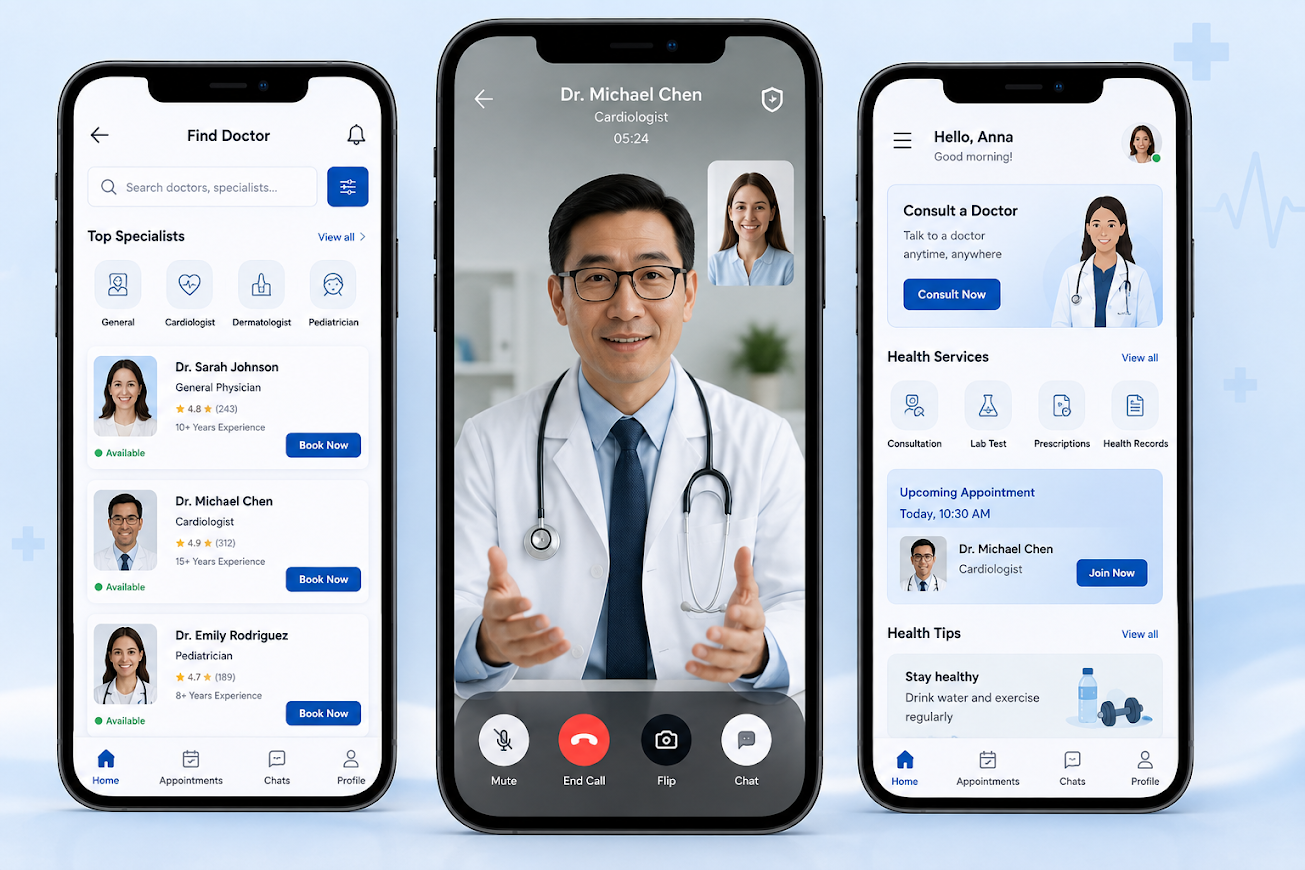
- Video consultations – synchronous visits for triage, follow-up, specialty consults, and therapy. Still the default modality for behavioral health.
- Audio consultations – phone-based care. Medicare now permanently allows audio-only when a patient cannot use or declines video, which matters for rural and older populations.
- Remote patient monitoring (RPM) – connected devices transmitting physiologic data between visits, mostly for hypertension, diabetes, heart failure, and post-discharge recovery.
- Mobile health (mHealth) – apps for medication adherence, symptom tracking, and patient-reported outcomes.
- Store-and-forward technology – asynchronous transmission of images and records, standard in teledermatology, teleradiology, and ophthalmology screening.
Why Telehealth Is the Future of Healthcare
The structural pressures point one direction. Clinician supply is not keeping pace with an aging, chronically ill population. Behavioral health demand exceeds in-person capacity almost everywhere. Payers and health systems are absorbing risk-based contracts that reward keeping people out of acute settings.
Virtual care addresses all three by decoupling clinical attention from physical location. The caveat, as anyone who has run a telehealth program knows, is that reimbursement policy has been the volatility not the technology. Medicare’s pandemic-era flexibilities lapsed twice, on 30 September 2025 and again on 30 January 2026, before the Consolidated Appropriations Act, 2026 extended them through 31 December 2027. Behavioral health telehealth in the home is permanent; most other flexibilities still carry an expiration date.
Top Telehealth Trends Transforming Healthcare
Behavioral health is the center of gravity. Mental health conditions were the top telehealth diagnostic category for every age group nationally in Q1 2026, at 52.1% of claim lines. Virtual-first behavioral health is no longer an adjacent market; it is the market.
Reimbursement is expanding toward shorter monitoring windows. The CY2026 Physician Fee Schedule introduced RPM code 99445 for 2–15 days of transmitted data in a 30-day period, plus 99470 for 10–19 minutes of management time, with parallel RTM codes. Programs previously had to hit 16 days to bill device supply. Episodic and post-discharge monitoring is now financially viable.
Ambient AI documentation moved from pilot to default. As of June 2025, 62.6% of US hospitals on Epic had deployed ambient AI scribing, though adoption skewed sharply toward nonprofit systems (70.2%) over for-profit ones (28.8%).
Prescribing rules remain unsettled. DEA flexibilities for tele-prescribing controlled substances run on a fourth temporary extension through 2026, with no permanent special registration framework finalized. Psychiatry, addiction medicine, and pain management programs should treat this as open risk.
Key Benefits of Telehealth
Better Access to Healthcare
Removes travel, transport, and time-off-work barriers the practical reasons rural, disabled, and shift-working patients miss appointments.
Reduced Healthcare Costs
Lower overhead per encounter, fewer avoidable ED visits, fewer no-shows. Savings are real but program-specific, and should be measured rather than assumed.
Improved Patient Engagement
Between-visit touchpoints and self-reported data create a more continuous relationship with the care team than quarterly appointments allow.
Faster Medical Consultations
Asynchronous triage and virtual urgent care compress time-to-first-contact from days to hours for low-acuity complaints.
Better Chronic Disease Management
RPM turns episodic snapshots into trend data, letting clinicians adjust therapy on evidence rather than recall.
Enhanced Mental Health Services
Virtual therapy expands the effective provider pool beyond a patient’s geography and lowers the stigma barrier to a first appointment.
Reduced Hospital Readmissions
Post-discharge monitoring catches deterioration inside the 30-day window, while it is still reversible.
Improved Care Coordination
Shared virtual access lets primary care, specialists, and care managers work from one record without serialized referrals.
Best Practices for Implementing Telehealth Solutions
Start from a clinical workflow, not a feature list. Programs that fail usually built a video tool and then went looking for a use case.
Design for EHR interoperability from day one FHIR-based integration, not CSV exports. Data that does not land in the chart does not change care.
Treat compliance as architecture: HIPAA safeguards, BAAs with every vendor, state licensure and modality rules, accessibility standards. Any internal team or telehealth app development company worth engaging should be able to show how these constraints shaped the build rather than how they were retrofitted afterward.
Instrument the program from launch — completion rates, time-to-appointment, readmissions, per-encounter cost. Plan for degraded connectivity and build an audio-only fallback path.
How Businesses Can Benefit from Telehealth Software Development
For providers, custom platforms remove the per-seat licensing and workflow compromises of off-the-shelf tools. For payers and employers, virtual-first products steer utilization. For device and pharma companies, RPM pipelines generate real-world evidence.
Build-versus-buy turns on differentiation: if your virtual care model is the product, owning the software matters. When evaluating a telehealth software development company, weigh healthcare-specific experience EHR integration, HL7/FHIR, HIPAA, clinical validation over general app portfolios. The same applies to a telehealth app development company handling patient-facing mobile work, where accessibility and device connectivity are the hard parts.
Conclusion
What telehealth removes matters more than what it adds. Distance, wait times, and scheduling friction kept patients from care they already qualified for; virtual platforms take those costs out of the encounter.
The direction of travel now is specialization condition-specific virtual care, broader remote patient monitoring as reimbursement widens, and decentralized trials that recruit outside academic centers. Each depends on software that fits clinical workflow and talks to the EHR, a higher bar than most healthcare app development work clears today. That bar is why the choice of a telehealth software development company shapes what a virtual care program can clinically do, not just how it looks, a decision that belongs alongside the care model, not after it.